

Buyer Guides
CNC

If you run a small or medium-sized US machine shop or manufacturing business and you are buying used machine tools, machinery, equipment or vehicles, Section 179 of the Internal Revenue Code lets you write off the full purchase price this year instead of over several years. Used equipment counts. A shop buying a $150,000 used CNC could cut its federal tax bill by $31,500 as a C corporation (21%), or by up to $55,500 if the profit is taxed in the top 37% personal bracket. The catch: the machine has to be installed and ready to use by December 31, so timing matters as much as price. That is where used machine tools win: they are already built. Our advice? Don't buy just for the tax break. But if you need the machine anyway, read on to see whether buying now pays off.
Looking to buy? See used machine tools in stock on Aucto, ready to ship before the year ends.
Contents
A quick high-level refresher on tax never hurts. The government charges a fee (tax) to all its citizens and businesses living and operating within its borders. In return, the government is supposed to hold up its end of the deal and keep the roads paved, the courts open, the lights on and the country safe. It is a relationship. The benefit of this system is that individuals and businesses have a place to grow and thrive. The drawback: you now have less money in your pocket.
The government realizes this and offers many programs and incentives to help reduce the amount of tax owed. Businesses pay taxes on net income, which is revenue less expenses and deductions. An expense is money that actually came out of your pocket. A deduction is something the IRS allows you to include to reduce the net income and in turn reduce taxes, for example depreciation on machinery, vehicles, computers or office furniture.
C corporations pay a federal corporate income tax rate of 21% on net income. Most states add their own corporate tax on top.
There are three ways to recover the cost of a machine:
In simple words, when you buy a machine for your business, Section 179 lets you expense the full cost or part of it in the year it is ready to use. This will increase your expenses and decrease your net income, meaning you owe less tax. You make this choice on your tax return, on Part I of IRS Form 4562. However, you have to meet certain criteria to opt for this.
Before opting for Section 179, make sure you meet the criteria below:
Rule 1: For 2026, the most you can write off is $2.56 million. If you buy a $3 million machine, you can write off $2.56 million, and the remaining amount can be depreciated the normal way or written off with bonus depreciation (see below).
Rule 2: If you buy more than $4.09 million worth of equipment, the $2.56 million cap starts to shrink dollar for dollar. If you buy $4.5 million worth of equipment in a year, that is $410,000 more than $4.09 million; therefore, $410,000 gets subtracted from the $2.56 million, and you can write off a maximum of $2.15 million. Basically, if you purchase $6.65 million or more of equipment, the write-off amount is $0.
Used machines get the same write-off as new ones, as long as they are new to you. For a machine shop, that matters twice.
Less cash for the same write-off. Well-maintained used machinery typically sells for 40–60% of the price of new, and you still write off 100% of what you pay. A used CNC lathe at half the price of new gets the full first-year deduction.
A machine you can have ready to use by December 31. New heavy CNCs can take 6 to 9 months to arrive. A used one is already built: once you find it, shipping and rigging take about a month and installation up to five business days, in our experience. If you are reading this in late November or December, the window is short. Only a machine you can have delivered and installed in the next few weeks counts for 2026. Anything later counts for 2027, which is fine if you need the machine anyway.
Alright… we have gone over what Section 179 is and the criteria you have to meet. Now, how does it benefit you as a buyer? To be blunt, it benefits small and medium-sized businesses the most. If you are a large manufacturer, the benefits are still there, but once you buy more than $6.65 million of equipment in a year, Section 179 drops to $0 and bonus depreciation takes over. But hey! A tax break is a tax break.
So, if you are a small to medium-sized business in need of machinery, the benefits are:
Section 179 is a federal rule. Most states follow the federal limits ($2.56 million for 2026), but some cap the write-off far lower on the state return. A buyer in one of these states still gets the full federal write-off, but a smaller state one, and depreciates the rest over several years on the state return.
| State | Section 179 cap | Bonus depreciation | Year-one state write-off on a $150,000 machine |
|---|---|---|---|
| California | $25,000 | Not followed | $25,000 |
| District of Columbia | $25,000 | Not followed | $25,000 |
| Hawaii | $25,000 | Not followed | $25,000 |
| Indiana | $25,000 | Added back | $25,000 |
| Maryland | $25,000 | Not followed (manufacturers follow federal) | $25,000 |
| New Jersey | $25,000 | Not followed | $25,000 |
| Kentucky | $100,000 | Not followed | $100,000 |
| Arkansas | $1,220,000 | Not followed | $150,000 |
Some states follow the federal Section 179 limit but do not allow bonus depreciation. Pennsylvania, for example, has followed the federal Section 179 limit for personal income tax since 2023, but allows no bonus depreciation. The Tax Foundation counts about two dozen states, plus DC, that do not follow federal bonus depreciation, including New York, Michigan and Massachusetts. For buyers in those states, Section 179 is the way to get a full first-year write-off on the state return.
State rules are based on each state's 2025 guidance. Check your state's rules for 2026.
What is bonus depreciation? Normally, the IRS makes you spread a machine's cost over several years (about 7 for most machine tools, per IRS Publication 946), deducting a slice each year. Bonus depreciation lets you skip the wait and deduct the full cost in the first year. It applies automatically unless you opt out.
So how is it different from Section 179? Both let you write off the full cost in year one, but bonus depreciation has no dollar cap and no profit limit, so it can even create a loss you carry to future years. Since the One Big Beautiful Bill Act (July 2025), it is 100% and permanent for equipment acquired after January 19, 2025, and used equipment counts as long as you never used it before (IRS Notice 2026-11; IRS bonus depreciation FAQ). Here is how the two compare:
| Section 179 | Bonus depreciation | |
|---|---|---|
| Write-off | Any amount up to 100%, you choose | 100% |
| Dollar cap (2026) | $2.56 million | None |
| Phase-out | Starts at $4.09 million of purchases | None |
| Profit limit | Cannot exceed business profit; the rest carries forward | None; can create a loss |
| Used equipment | Yes, if new to you | Yes, if you never used it before |
| How you use it | Opt in, item by item | Automatic unless you opt out |
| State tax | Some states cap it at $25,000 | Many states do not follow it |
In practice, Section 179 gives you control over how much to write off, while bonus depreciation covers big buyers and businesses running at a loss. Many businesses use both.
So why use Section 179 at all? Two reasons. First, state taxes: about two dozen states and DC do not follow federal bonus depreciation, but most of them allow Section 179, so it can still get you a state write-off (see the state table above). Second, control: Section 179 lets you choose the exact amount, machine by machine, while bonus depreciation is all or nothing for a whole class of equipment. If you are under the cap, profitable and in a state that follows bonus depreciation, either one works.
Below is our strategy guide on how to leverage Section 179, in three steps: profit and need, time, and money. If you are the more visual type, the diagram below can help you visualize your strategy:
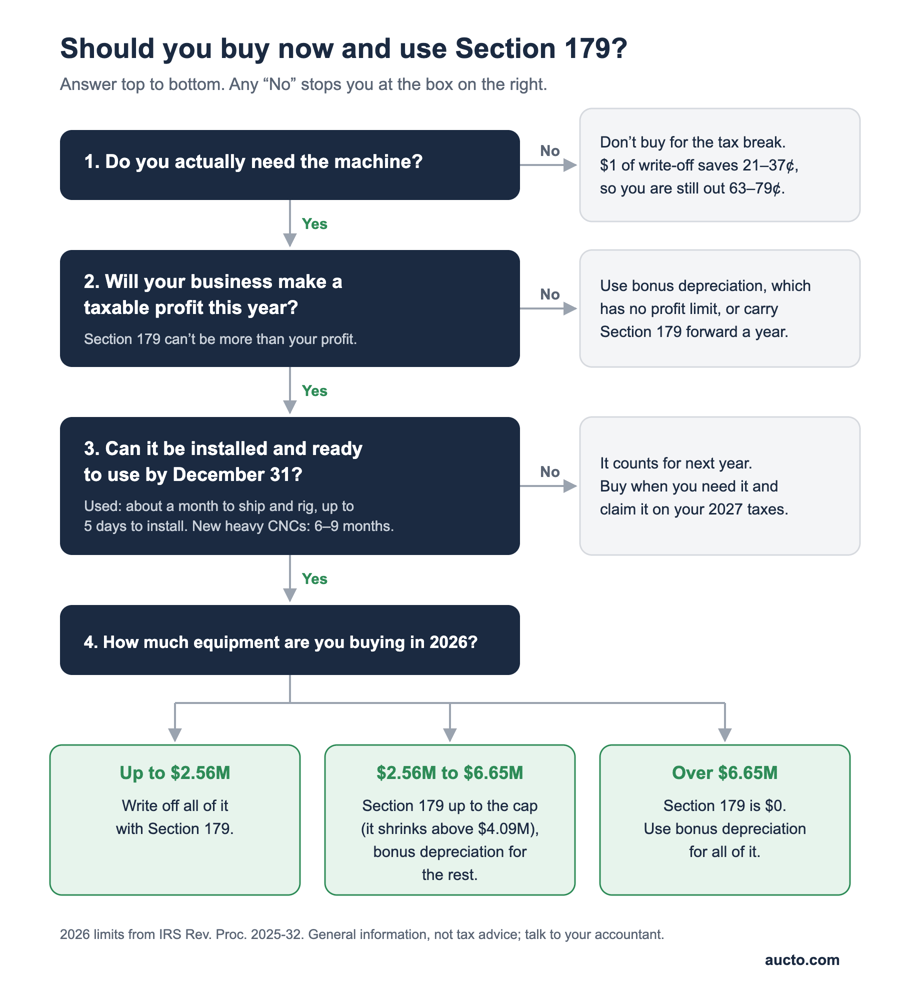
Step 1: Profit and need. Will your business make a taxable profit this year? Section 179 can't be more than your profit. If you're breaking even or losing money, it gives you nothing this year, though the unused amount carries forward. Bonus depreciation has no profit limit, so it still works.
Then ask: do you actually need the machine, and will it earn more than its after-tax cost? If not, stop here. Do not buy for the deduction. Spending $1 saves 21 to 37 cents in tax, so you are still out 63 to 79 cents.
Step 2: Time. When will it be ready to use? Section 179 follows the date the machine is ready to use, not the purchase date. Find the quarter you buy in and how long the machine takes to arrive and install. New heavy CNCs can take 6 to 9 months. Purchasing used equipment is faster: once you find the machine, shipping and rigging take about a month and installation up to five business days, so most used machines fall in the 0–3 month row. Buying in late November or December is tight even for used, so move quickly or plan for next year.
| Time to arrive and install | Buy Jan–Mar | Buy Apr–Jun | Buy Jul–Sep | Buy Oct–Dec |
|---|---|---|---|---|
| 0–3 months | This year | This year | This year | Tight |
| 3–6 months | This year | This year | Tight | Next year |
| 6–9 months (new heavy CNCs) | This year | Tight | Next year | Next year |
Step 3: Money. How much equipment are you buying this year?
| Equipment bought in 2026 | Section 179 write-off | Strategy | Example |
|---|---|---|---|
| Up to $2.56 million | All of it | Use Section 179. | A machine shop buys a $150,000 used CNC lathe. It writes off all $150,000. |
| $2.56 million to $4.09 million | Up to $2.56 million | Section 179 up to the cap, bonus depreciation on the rest. | A manufacturer buys $3 million of equipment. It writes off $2.56 million under Section 179 and the other $440,000 with bonus depreciation. |
| $4.09 million to $6.65 million | Cap shrinks dollar for dollar | Section 179 on what is left of the cap, bonus depreciation on the rest. | A manufacturer buys $5 million of equipment. That is $910,000 over the line, so the cap shrinks to $1.65 million. Bonus depreciation covers the other $3.35 million. |
| Over $6.65 million | $0 | Use bonus depreciation. | A plant buys $8 million of equipment. Section 179 is $0, so bonus depreciation covers all $8 million. |
In every tier, the Section 179 part cannot be more than your business profit for the year. The rest carries forward. Bonus depreciation has no profit limit. Cash tight? Finance it. Financed equipment still qualifies for the full write-off.
If the strategy says buy, start with equipment that is in stock and can be ready to use before December 31. Browse used machine tools on Aucto, from CNC machining centers to milling machines and grinding machines. Buy now or make an offer, directly from verified sellers.
This article is general information, not tax advice. Talk to your accountant about your situation.
