KALTENBACH KBS 400 DG HORIZONTAL BAND SAW
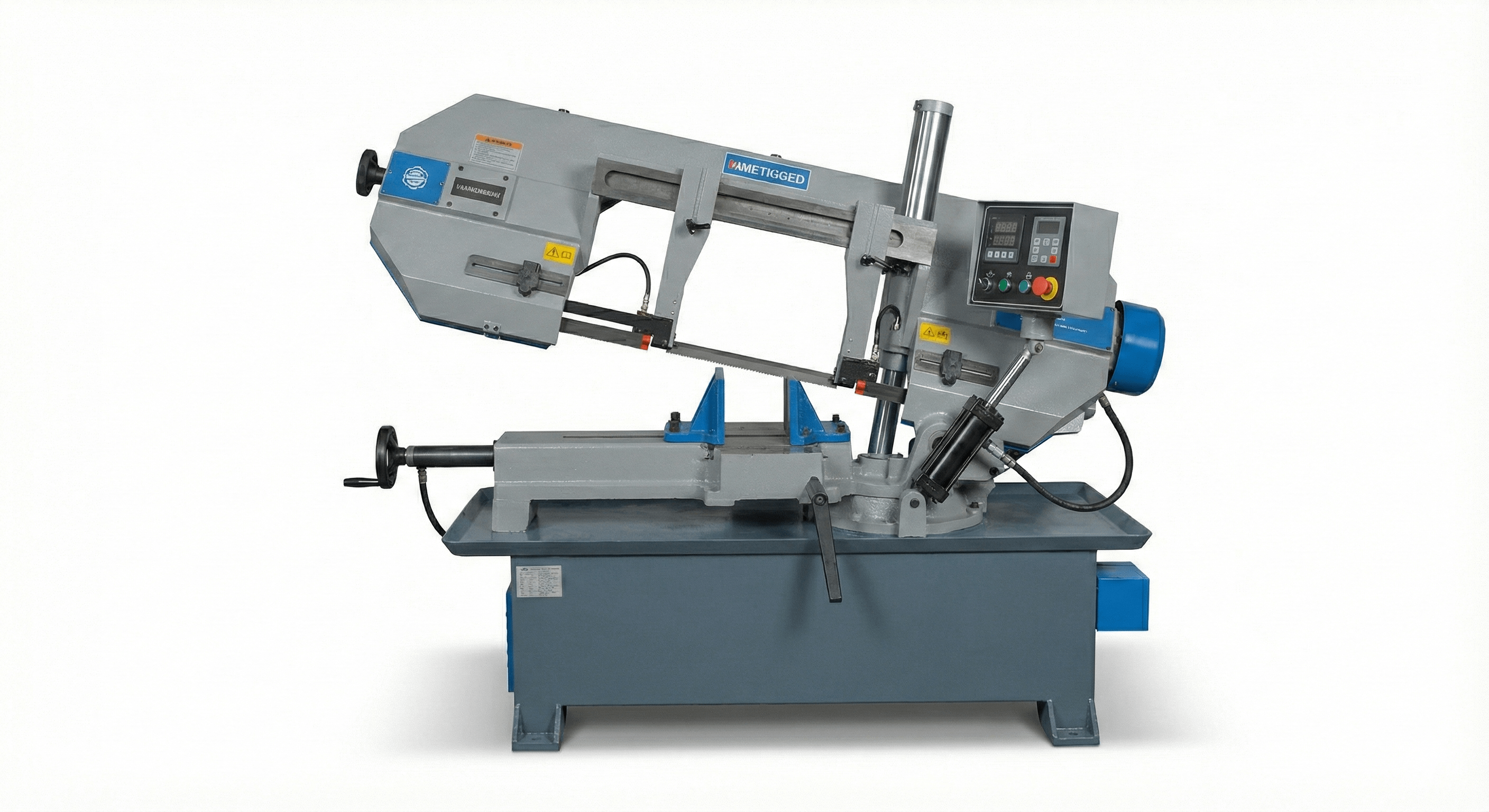
Equipment Overview
Share Link- OEM
- KALTENBACH
- Model
- KBS 400 DG
- Year of Manufacture
- -
- Category
- HORIZONTAL BAND SAWS
Market Value Calculator
A+Technical Description
The KALTENBACH KBS 400 DG Horizontal Band Saw is engineered for precision cutting with a robust design, featuring a rectangular capacity height of 13.78 inches and width of 17.72 inches. It operates with a powerful motor offering options of 4.02 horsepower (3.0 kW) or 10.05 horsepower (7.5 kW), ensuring efficient performance across various materials. The machine boasts a working range of 39.76 inches by 19.69 inches (1010 x 500 mm), making it suitable for larger workpieces. With overall dimensions of approximately 142.13 inches in length, 45.67 inches in width, and 95.28 inches in height (3,610 x 1,160 x 2,420 mm), it is designed for industrial environments. The saw weighs around 7,936.64 lbs (3600 kg) or 8,598.02 lbs (3900 kg), providing stability during operation. It accommodates saw blade dimensions of either 294.3 inches x 1.61 inches x 0.05 inches (7,470 x 41 x 1.3 mm) or 225.59 inches x 1.34 inches x 0.043 inches (5,730 x 34 x 1.1 mm). The cutting speed ranges from 49.2 to 393.7 ft/min (15 to 120 m/min) or 49.2 to 295.3 ft/min (15 to 90 m/min), while the saw band feed can be adjusted from 0 to 15.75 inches/min (0 to 400 mm/min) or 0 to 11.81 inches/min (0 to 300 mm/min). The sawband inclination is set at 3 degrees, and it offers a mitre range of -45° to 90° and +30° or -45° to 60°, enhancing its versatility for various cutting applications.
Technical Attributes
- Rated Power
- 4.02 HP
Data Accuracy and Verification
Specifications and technical details are compiled from manufacturer documentation, historical records, and third-party industry sources. While care is taken to ensure accuracy, this information is provided for reference purposes only and may contain errors or omissions. Users should independently verify all details before relying on them.
If you identify any inaccuracies, please help us improve our data by reporting them here.